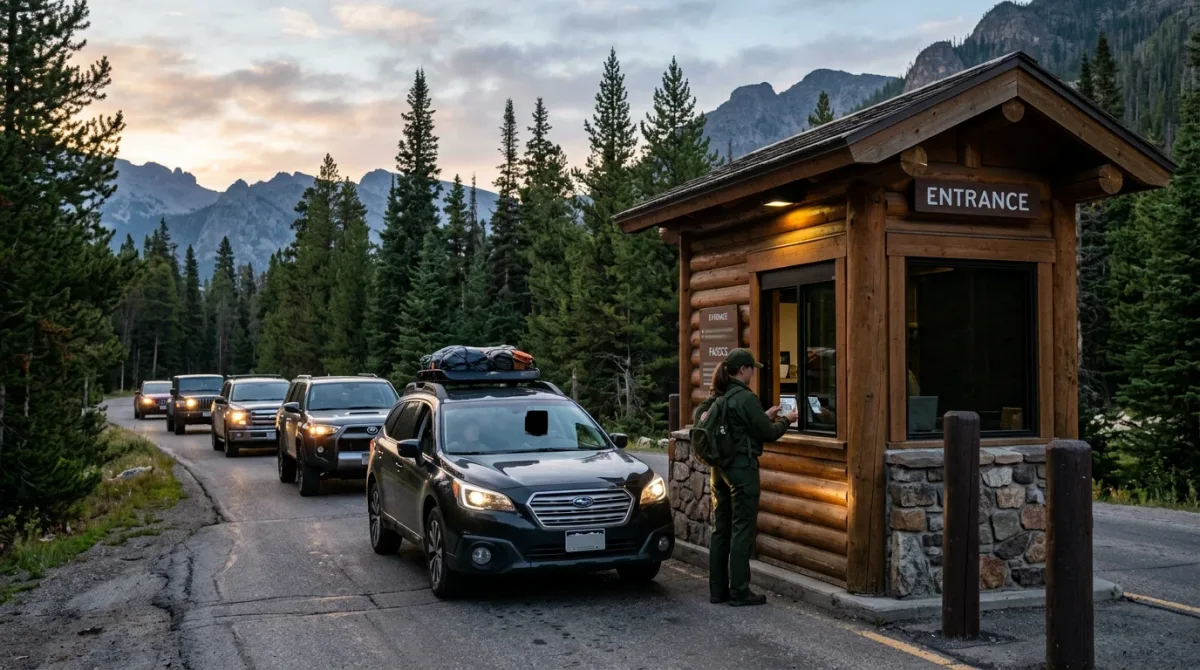
If you are not a U.S. resident, entering one of 11 headline national parks now costs an extra $100 per person aged 16 or older, on top of the standard entrance fee, under a National Park Service policy that took effect January 1, 2026. Children 15 and under are exempt, and one annual pass can cover a party of four.
That is the whole change in a sentence, but the planning consequences are bigger than the number suggests. The surcharge is per person, not per vehicle, so a family of four adults arriving in one car at Yosemite pays four surcharges plus the vehicle fee. Below is what the agencies themselves have published, and how to work the math before you book flights.
What exactly changed on January 1, 2026?
Two things changed at once. The America the Beautiful annual pass split into two prices — $80 for U.S. residents and $250 for nonresidents — and a $100 per-person nonresident entrance fee was added at the 11 most-visited national parks, according to the Department of the Interior announcement of November 25, 2025.
The Interior Department framed it as a revenue measure. Secretary Doug Burgum said in that announcement that the policies "ensure that U.S. taxpayers...continue to enjoy affordable access, while international visitors contribute their fair share." The same announcement added eight fee-free days across 2026 for U.S. residents and moved passes onto Recreation.gov in digital form from January 1, 2026.
The National Park Service's own nonresident fee guidance, last updated July 15, 2026, is the page to check before you travel — fee policy at this scale tends to accumulate clarifications, and conditions change, so confirm with the park you are visiting before you go.
Which parks charge the $100 nonresident fee?
Eleven parks, and the Park Service names them: Acadia, Bryce Canyon, Everglades, Glacier, Grand Canyon, Grand Teton, Rocky Mountain, Sequoia & Kings Canyon, Yellowstone, Yosemite and Zion. Everywhere else in the system, the standard entrance fee applies as before.
That list matters for routing. A Utah trip built around Bryce and Zion hits the surcharge twice unless you hold the nonresident annual pass. Swap in Capitol Reef, Canyonlands or Arches for part of the itinerary and those days fall outside the surcharge list — though entrance fees still apply and each park sets its own. Check each park's fees page rather than assuming, and note that NPR reported the surcharge sits on top of the standard $35 vehicle pass at the parks that charge it.
When does the $250 nonresident pass pay for itself?
Fast. The America the Beautiful Non-Resident Annual Pass costs $250 (plus $7.50 in fees when ordered through the USGS store) and covers the pass holder plus three additional nonresidents aged 16 and over for per-person fees, or the holder's vehicle where fees are charged by vehicle, per the U.S. Geological Survey store listing for the 2026 pass.
Run the arithmetic for two adults visiting two surcharge parks: that is $400 in surcharges alone before entrance fees. The pass wins. A solo traveler visiting one park does better paying at the gate.
| Option | Price | Who it covers | Best for |
|---|---|---|---|
| Pay at the gate (nonresident) | $100 per person 16+, plus the park's standard entrance fee | One person per fee | A single visit to one surcharge park |
| Non-Resident Annual Pass | $250 (+$7.50 fees via the USGS store) | Holder plus three others aged 16+; under-16s free | Two or more surcharge parks, or groups |
| Resident Annual Pass | $80 | U.S. residents only, with ID | Residents visiting several fee sites |
The nonresident pass is not limited to the 11 parks. The USGS listing says it covers entrance and nonresident fees at sites managed by six federal agencies, including the Forest Service, Bureau of Land Management and Fish and Wildlife Service — useful if your trip strings together national forest trailheads and park days.
How do you prove U.S. residency at the gate?
With a document, not a statement. The Park Service lists three acceptable proofs: a U.S. passport, a U.S. government (state or territory)-issued driver's license or state ID, or a Permanent Residency card. Bring one if you are a resident and expect to be asked.
Pass holders should also plan on ID. The Park Service's entrance passes page, last updated January 5, 2026, states that pass holders must present valid photo identification with each use, and that passes other than the standard park pass are non-refundable, non-transferable and cannot be replaced if lost or stolen. The USGS store adds a detail worth reading twice: receipts, photos and copies of a pass are not valid — carry the physical card or the digital pass itself.
What about guided trips and commercial tours?
If you book a guided trip as a non-U.S. resident, you pay both the standard entrance fee and the $100 nonresident fee unless you hold the nonresident annual pass, per the Park Service's commercial tours guidance. Operators were given a mechanism of their own: as of June 2026, tour companies can prepay commercial entrance and nonresident fees by buying a Commercial Site Pass on Recreation.gov.
Ask your outfitter, in writing, whether the quoted price includes the nonresident fee. On a multi-park guided itinerary the difference is hundreds of dollars per person, and the answer is not standardized across operators.
How should you build this into a 2026 trip plan?
- Count the surcharge parks on your route. Two or more, or a group of two or more adults, and the $250 pass is the cheaper path.
- Buy early. Digital passes are available immediately on Recreation.gov; physical passes ship within five business days from USGS, with transit on top, so order weeks ahead if you want the card.
- Pack the ID that matches your status — passport, state-issued license or ID, or Permanent Residency card.
- Confirm each park's own entrance fee, which is separate from and unchanged by the surcharge.
- Re-check the Park Service nonresident fee page shortly before departure. It has been revised since launch, and it is the page rangers work from.
One more note for residents reading this: the 2026 fee-free days announced by Interior — including Presidents Day on February 16, Memorial Day on May 25, and the Park Service's 110th birthday on August 25 — apply to U.S. residents. If you are planning around them, expect company at the entrance stations.
Fees, effective dates and park lists are set by the managing agencies and can be revised. Check the National Park Service nonresident fee guidance and the park you are visiting before you go.
For a related business news perspective, read What to Know About Federal Recreation Fees Before You Book.
For more context, read How Backcountry Permit Lotteries Actually Work.
For more context, read How to Get a Half Dome Permit in 2025.
For more context, read Venice Expands Day-Tripper Access Fee to 54 Days for 2025.