
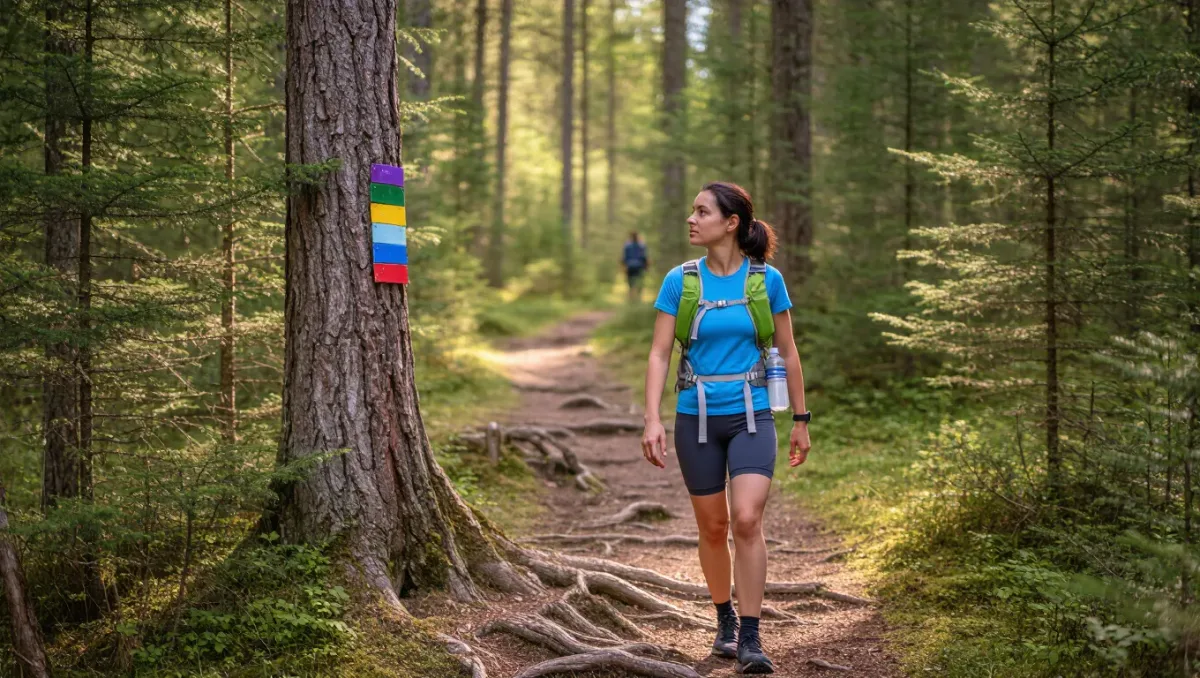
A first solo hike goes well when three things are in place before the trailhead: a short, well-marked, popular route where other hikers pass regularly; a written itinerary — route, vehicle, and a firm check-in time — left with someone who will act on it; and the core skills of navigation and the ten essentials already practiced, since solo hiking simply removes the partner who would otherwise cover mistakes, per the trip-planning guidance published by land agencies such as the National Park Service and the U.S. Forest Service. Pick that triangle correctly and the day feels less like an expedition and more like what it is: a walk you happen to be taking alone.
This guide walks through route choice, the plan you leave behind, gear with no redundancy, and the judgment habits that experienced solo hikers actually rely on. It publishes planning information, not a guarantee of safety — solo travel concentrates consequence, and honest route selection is the whole game.
What kind of route suits a first solo hike?
One you have essentially already done the research on: a trail within an hour of home, 5 to 8 miles, well marked, moderately popular, with phone or no-service clarity known in advance. Popularity is a feature on a first solo — other hikers are passive companionship and a practical safety net, per the general advice agency hiking pages give beginning hikers. Choose terrain with one or two clean exits if the map offers them, avoid route-finding scrambles and unbridged creek crossings, and skip anything the managing agency flags for closures, fire damage, or hazard. The classic first-solo formula is a loop you have partially walked before, because familiarity removes half the mental load.
What itinerary should you leave, and with whom?
A written trip plan with four facts: where you are going (trailhead and route), what vehicle and plate you are driving, when you will be back, and when to call for help if you have not checked in — left with a person who has agreed to act, not just told, per the trip-plan templates land agencies publish for hikers. Set the call time generously but definitely: “if you have not heard from me by 8 p.m., call the county sheriff” is a complete instruction. Then honor it — a solo hiker whose plan is fiction teaches the contact to ignore it. A satellite communicator with a check-in function turns this step from anxiety management into a two-tap habit, and it is the single most reassuring piece of electronics a new solo hiker can carry where coverage is thin.
What gear changes when nobody else carries the spares?
You become the group, so the ten essentials stop being a checklist exercise and become a load: navigation (map plus compass or a GPS with the route downloaded and a paper backup), insulation beyond the forecast, a headlamp with fresh batteries, first aid you actually know how to use, fire, repair kit and knife, extra food and water or treatment, and an emergency shelter, per the essentials lists agencies and outdoor education programs publish. The solo-specific additions are small but real: a satellite communicator or PLB, a copy of your trip plan in the car, and footwear proven on similar ground — the day a boot fails is bad enough with a partner.
| Solo planning item | Standard | Why it matters alone |
|---|---|---|
| Route | Marked, popular, 5-8 mi, known exits | Route-finding errors have no partner safety net |
| Trip plan | Written, with a firm check-in deadline | Someone must know to look, and where |
| Navigation | Map plus downloaded GPS track | You carry both the judgment and the backup |
| Communication | Satellite communicator or PLB | Coverage gaps stop being silent risks |
| Timing | Start early, off trail before dark | Night travel alone is where errors compound |
Related stories: How to Layer for Winter Day Hikes: A Three-Layer System That Works · Hiking in Extreme Heat: How to Stay Safe Above 90 Degrees.
How do you handle the mental side of hiking alone?
With graduated exposure, not bravado. Start with the popular half-day loop, then lengthen, then add an unfamiliar trail, then a service gap — each step teaches your nervous system that the plan works. Most first-solo anxiety concentrates in two moments, the empty trailhead parking lot and the first long quiet mile, and both pass faster than expected. Practical habits help: music or podcasts in one ear where rules and sense permit on safe, busy trails; a firm turnaround time written into your plan; and the standing instruction solo hikers repeat — trust the small voice. If a situation reads wrong, whether a person, a storm, or a trail condition, turning around early is the whole skill, and nobody sees it but you.
Tell someone your plan, honor your check-in time, and check current trail conditions with the managing agency before you go — the three habits that carry every solo hike.
What should you skip on a first solo?
Off-trail shortcuts, river fords above knee depth, exposure you have never belayed or scrambled with others, and any route whose description contains the words ”route-finding required” — solo is not the context in which to learn them, and agency trail pages flag them for a reason. Save the first solo night hike, the first solo winter trip, and the first solo backpack as separate graduations; each adds a skill layer that deserves its own deliberate step rather than a heroic combination.
Frequently asked questions
Is hiking alone actually safe?
On prepared, marked, reasonably popular trails with a filed trip plan, incidents involving solo day hikers are rare, and the risks that matter — navigation errors, ankle injuries, weather — are the same risks partner hiking manages. Solo changes consequence, not likelihood, which is why the planning steps concentrate on rescue logistics.
Do you need a satellite communicator?
Not on a short, busy, coverage-solid trail — but many favorite trails have dead zones, and a communicator converts ”no signal” from a hazard into a non-event. For anything remote or unfamiliar, it is the cheapest serious upgrade a solo hiker can make.
What if you get lost on a solo hike?
Stop at the moment certainty ends, per standard lost-person guidance from land agencies: consult the map, backtrack to the last known point, and if the way back is unclear, stay put, make yourself visible and warm, and use the communication plan you filed. Wandering to ”just see around the corner” is the error search-and-rescue teams cite most.