
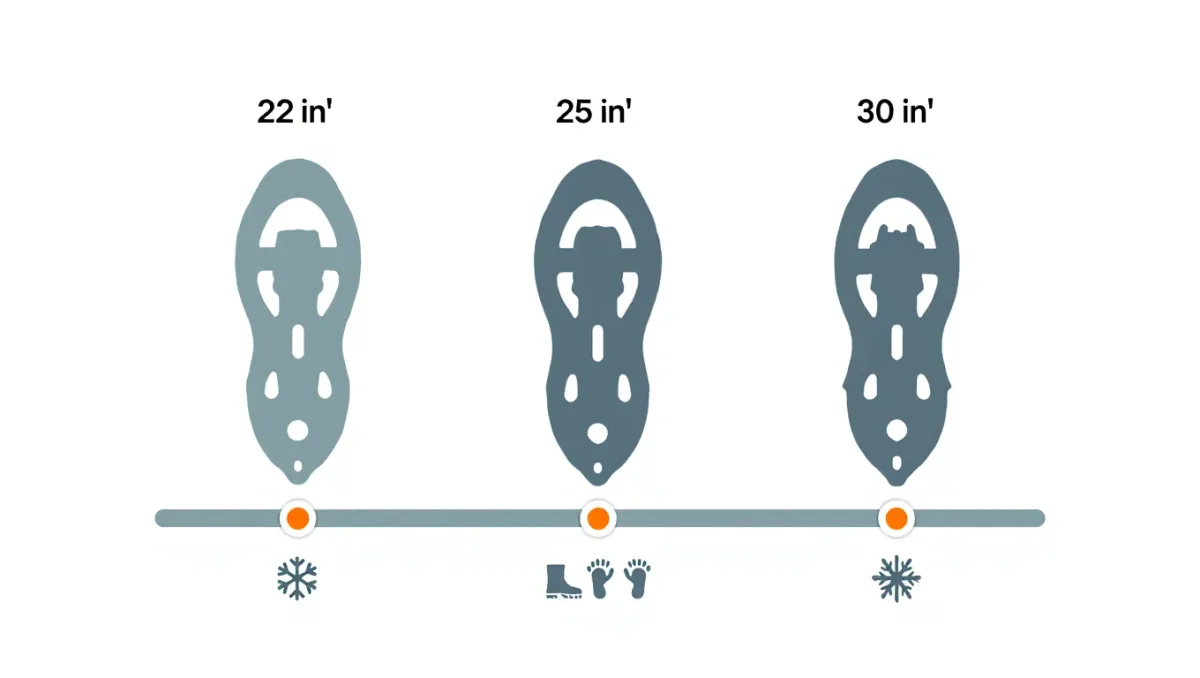
Choosing snowshoes means matching three things from the manufacturer's own documents: your total load (body weight plus pack, the number every sizing chart starts with), the terrain class — flat, rolling, or mountain — and a deck size in the standard 20-to-30-inch range that turns that load into flotation on the snow you actually walk. A 25-inch pair covers most packed-trail and mixed-snow day hiking for a hiker and daypack in the mid-weight range, per the sizing charts published by the major snowshoe makers such as MSR, Tubbs, and Atlas, while bigger loads or powder demand more deck; icy packed trails demand less.
This guide reads those charts and categories so the purchase fits your winter, and it closes with the packing and care notes the manufacturers include with their manuals. It publishes information about equipment, not a guarantee of flotation — snow is variable, and even the right shoe sinks sometimes.
How does snowshoe sizing actually work?
By load, not by height. Every manufacturer publishes a chart that maps total weight — you plus everything you carry — to a recommended deck size, because flotation is physics: a heavier load needs more surface area to sit on top of a given snowpack. Typical chart logic from current spec sheets runs like this: 21-22-inch decks carry lighter hikers on packed terrain, 25-inch decks serve the broad middle of day hikers, and 30-inch decks exist for big loads, powder, and breaking trail. On the chart's boundary, the rule of thumb the manufacturers give is to size for the heavier condition — choose the larger size if you will regularly break fresh snow, and add optional flotation tails (where offered) rather than buying two pairs.
| Deck size | Typical load range | Best snow and terrain |
|---|---|---|
| 21-22 in | Lighter hikers, light packs | Packed trails, dense spring snow |
| 25 in | Middle of most charts | All-purpose trail and rolling terrain |
| 30 in | Heavier loads, big packs | Powder, breaking trail, winter camping |
What are the terrain categories?
Manufacturers sort every line into three honest classes. Flat-terrain models are the entry level: simple bindings and modest traction for parks and groomed paths. Rolling-terrain models add stronger cleats under the arch and heel, better bindings, and are the all-purpose choice most buyers actually need. Mountain or technical models add climbing-style toe crampons, lateral traction bars, and heel-lift risers — the plastic bar that props your heel on long climbs to save calf burn — for steep, icy, backcountry routes. The mistake to avoid is symmetric: buying the flat model for mountain use buys slips, and buying the mountain model for park loops buys weight and a stiff walk.
Related stories: How to Choose Trekking Poles: Material, Locks, and Fit · How to Layer for Winter Day Hikes: A Three-Layer System That Works.
Which traction and binding details matter?
Look at three spots on the spec sheet. Under the toe: the front crampon's teeth depth matters on icy trails more than anything printed about the deck. Under the arch: side rails or traction bars keep you tracking straight on sidehills. At the binding: the difference between classes shows up here — padded, wrapping bindings hold a boot secure on traverses, while basic straps loosen in miles. Compatibility is the quiet question: check the manufacturer's boot-size range against your actual winter boots, and note that snowboard boots and heavy pac boots need bindings sized for volume.
What about snow conditions and adjustability?
The same pair behaves differently across the season. Powder asks for maximum deck; spring corn and dense packed snow let you shrink your footprint or even walk in smaller shoes. Heel lifts are the mountain class's gift on long ascents, and most all-purpose models now offer modular tails for the deep days. Poles with snow baskets belong with any pair — the manufacturers' own technique guidance has you pushing off poles on climbs and probing depth at creek crossings, where a snow bridge is the winter trail's classic hidden hazard.
Snow conditions change weekly — check the avalanche forecast and trail reports for your area before any winter outing, and never cross a creek on an unproven snow bridge.
How do you care for snowshoes?
Dry them like any winter gear: knock off snow, wipe the decks, and store them unstrapped and out of direct sun, per the care sections of manufacturer manuals. Check binding straps and buckles for cracking at season's end, and re-tighten any riveted hardware per the manual's instructions. Aluminum frames and steel crampons will rust if stored wet — the garage floor after a slushy March hike is where snowshoes go to die.
Frequently asked questions
Do you size snowshoes by body weight or height?
Weight — body plus pack. Every manufacturer chart maps total load to deck size, and a loaded winter-camping pack can push you a size up even though your body has not changed, per the charts published by MSR, Tubbs, and Atlas.
Are more expensive snowshoes worth it?
At the rolling-terrain class, yes for anyone beyond park loops: the traction, bindings, and durability differences are real and named on the spec sheets. The mountain class pays off only if steep icy terrain is genuinely on your winter map.
Can you use snowshoes on icy trails?
With the right model, yes — mountain-class shoes with aggressive toe crampons handle icy packed trails well, and microspikes remain the lighter tool for pure ice. Flat-terrain snowshoes on ice are the combination to avoid.