
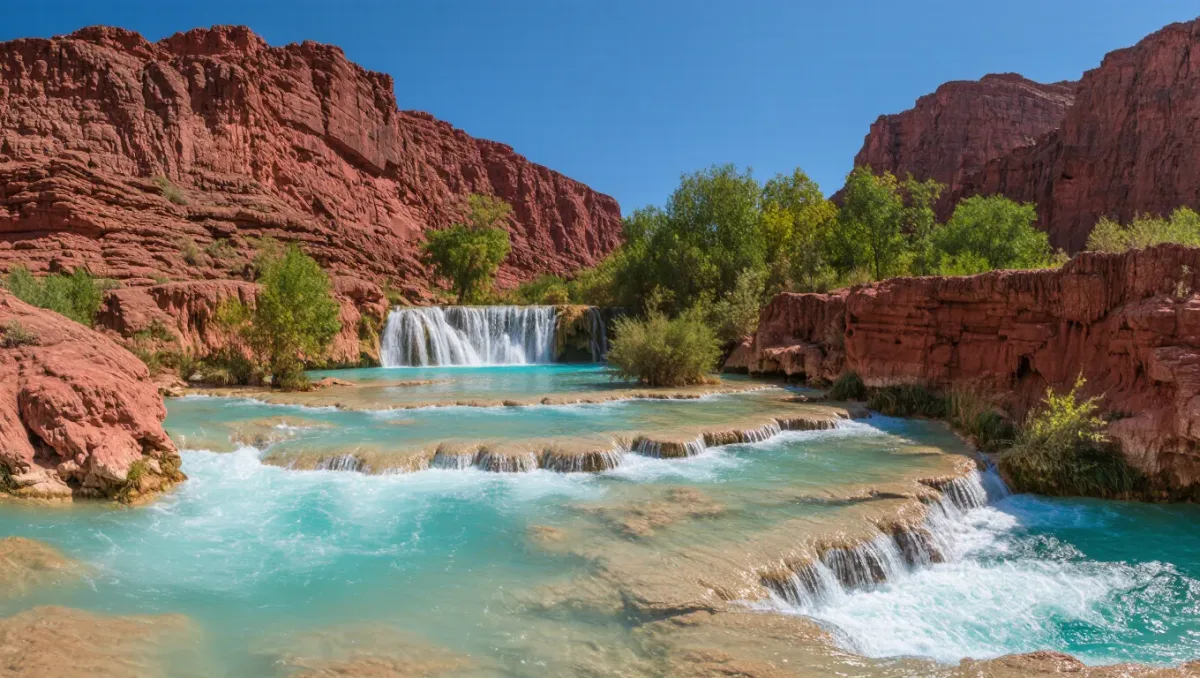
Hiking to Havasu Falls requires an overnight reservation bought in advance from the Havasupai Tribe — day hiking is not permitted on the reservation, per the tribe's official reservation rules as of 2025 — and the commitment is physical as well as bureaucratic: about 10 miles one way from the Hualapai Hilltop trailhead to Supai Village, then roughly 2 more miles to the campground beside Havasu Creek, all of it inside the Havasupai Indian Reservation on the south side of the Grand Canyon. Reservations for the season typically sell out far in advance of any given date, so this trip is planned backwards from the booking, not the other way around.
The reward is water most desert hikers never see: a chain of calcium-carbonate-buffered springs feeding turquoise pools and waterfalls — Havasu, Mooney, and Beaver Falls among them — in a red-walled side canyon of the Grand Canyon. This guide covers the reservation system, the trail, the rules the tribe enforces, and the heat and flood realities that the canyon's incident history keeps underscoring.
How do reservations for Havasu Falls work?
Through the tribe's own online reservation system only. The Havasupai Tribe sets per-night, per-person fees that bundle the permit, campground use, and related charges, and the published amounts have risen repeatedly in recent years — check the official Havasupai reservations website for current rates rather than any older figure. Reservations are tied to the names of the guests, who must carry matching photo ID at the trailhead check-in; reservations are not transferable, and the tribe enforces this. The system typically opens reservations for the coming season in a announced window — historically in early February — and popular months book within hours, per the tribe's published process. Any website or reseller other than the official one is not the source of a valid permit.
How hard is the hike in?
The numbers look easy and the canyon makes them real. From Hualapai Hilltop at the end of Indian Road 18, the trail descends a switchbacking canyon wall, then walks about 8 miles of open, sandy wash to Supai Village — the trail in is downhill-trending, which is exactly why so many hikers underestimate it: the return climb out of the canyon comes after a night on the ground, often in heat, with the same 10 miles ahead of you. Hikers carry their own gear in and out; the tribe's pack animal service hauls gear for a fee by arrangement, per the tribe's posted services, but every visitor still walks. Most parties start before dawn to bank cool miles; the open wash offers no shade to speak of.
What are the rules once you are on the land?
You are a guest of a sovereign tribal nation, and the rules are the tribe's, not the National Park Service's — the reservation sits within the Grand Canyon but outside the national park's jurisdiction. Published rules include: camping only in the designated campground, no drones, no alcohol or drugs, no climbing on or jumping from the falls, no swimming at some sites as posted, no pets beyond service animals, and photography of tribal members only with permission, per the Havasupai Tribe's visitor guidelines. Leave No Trace applies with extra force here — the canyon floor is the tribe's homeland, and pack-out culture is expected of every guest. Respect posted closures without debate; flash-flood damage and trail work close areas without notice.
| Fact | Detail (per Havasupai Tribe, as of 2025) |
|---|---|
| Reservation required | Yes — overnight only, via the tribe's official online system |
| Distances | About 10 mi trailhead to Supai; about 2 more to the campground |
| Check-in | At the tourist office in Supai; photo ID matching the reservation |
| Camping | Designated campground only, roughly 2 mi below Supai |
| Prohibited | Day hiking, drones, alcohol, climbing the falls, unauthorized photos of residents |
| Season risk | Summer heat and monsoon flash floods; spring and fall are the comfort seasons |
Related stories: What to Know Before You Hike to The Wave in Coyote Buttes North · How to Section Hike Vermont's Long Trail: Planning the 272 Miles.
When should you go?
Spring (roughly March through May) and fall (roughly September through November) are the planning sweet spots: daytime highs in the range where 24 miles round trip is honest work rather than a heat casualty statistic, and campground nights that do not require heroic sleep systems. Summer is the season the images sell and the conditions punish — canyon temperatures at or above 100°F, no shade on the wash, and monsoon-season flood risk on Havasu Creek, which the tribe and Grand Canyon-area agencies both warn about. If a summer reservation is what you could get, plan pre-dawn starts both directions, carry more water capacity than seems reasonable, and treat any day the sky over the rim looks dark as a short-travel day.
What should you pack differently for Havasu?
Water discipline above all: the spring at the campground serves the village area and is treated as a source to filter like any other, per standard backcountry practice, but the ten approach miles are dry. Bring electrolyte replacement, a wide-brim hat, and the foot care kit your longest training hike proved out. Camp shoes that can get wet earn their place at the falls; so does a dry bag for gear at the waterline. Cell service is effectively absent in the canyon, the emergency plan is the tribe's posted procedures and your own party's judgment, and a satellite communicator is the modern baseline for trips this far from the trailhead.
You are hiking on tribal land, not park land — the Havasupai Tribe's rules, fees, and procedures govern everything, and they change. Confirm all current details on the tribe's official site before you book and again before you drive.
Route facts
- Destination: Havasu Falls and the Havasu Creek canyon, Havasupai Indian Reservation, Arizona
- Distance: about 10 mi from Hualapai Hilltop to Supai Village, about 2 more to the campground; roughly 24 mi round trip to the falls area
- Difficulty: strenuous by distance and heat exposure, not by technicality; no shade on the wash
- Permit: overnight reservation from the Havasupai Tribe, required for all visitors; fees per the tribe's current schedule (as of 2025)
- Season: spring and fall recommended; summer demands heat and flood discipline
- Managing authority: Havasupai Tribe
- Conditions change — check the tribe's current rules, fees, and advisories before you go
Frequently asked questions
Can you day-hike to Havasu Falls?
No. The Havasupai Tribe permits only overnight guests, per its published reservation rules — a reservation and campground booking are required for everyone who enters. The nearest walk-up alternative in the region is the national park's Rim trail system, which is a different experience entirely.
How far in advance do reservations open up?
The tribe has historically opened the season's reservations in a single window in early February, and popular dates have sold out within hours, per the tribe's published process. Watch the official Havasupai reservations website for the announced opening, and have your group's names and dates ready before it opens.
Is the water at the campground drinkable?
A spring serves the campground area, but standard backcountry practice is to treat all sources; carry a filter or chemical treatment. The ten miles between the trailhead and the canyon bottom are dry, so start with full capacity and drink on schedule rather than on thirst.
How dangerous are flash floods on Havasu Creek?
Serious enough that both the tribe and Grand Canyon-area land agencies publish standing flood warnings: rain falling on the rim can send a flood down the narrow canyon hours later, and the campground sits at the waterline. Watch the sky, know the tribe's evacuation guidance posted at check-in, and camp prepared to move at night if conditions turn.